|
NO TIME TO FORGET – 25 years of the EVZ
Through to June 13, 2026, the EVZ Foundation is marking its anniversary with a wide range of projects and activities in Germany and across Europe.
Today, December 1, the Foundation launches its EVZ Academy – online platform!, offering learning formats on Nazi forced labor, diversity awareness, human rights and memory culture.
The launch will be streamed live on YouTube at 11 a.m. Afterwards, the platform will be freely accessible to everyone. Selected offerings will be featured in our newsletter section Pearl Finder.
Also on December 1, the network event EVZ Connect brings together partner organizations and project executing agencies from 25 years of Foundation work with the aim of developing forward-looking responses to current challenges.
On December 2, 2025, the EVZ Foundation celebrates its 25th anniversary with representatives from politics, business and civil society, both in Germany and partner countries. Eleven survivors of Nazi persecution will attend as guests of honor: their presence will make the evening a profoundly meaningful moment of encounter.
Federal President Frank-Walter Steinmeier is the patron of the anniversary year and will speak at the event. Companions and partners will offer their personal reflections on lived remembrance and commitment – they also share their stories in the video series #25EVZVoices.
This issue also highlights additional anniversary formats – from the history festival EVZ Histoday and the podcast Wert & Würde [Value & Dignity] to the Volny Choir and the touring exhibition Ma Bistrass!
|
| |
|
|
ANNIVERSARY EVENT
|
|
|
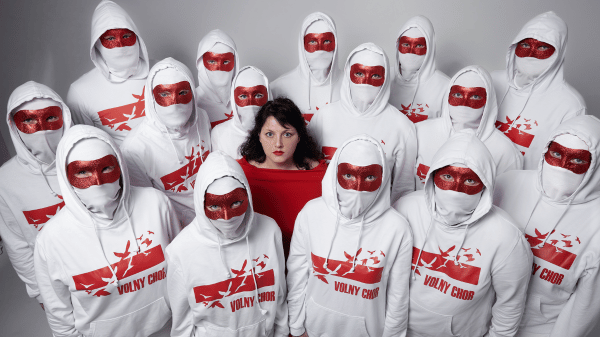
Where is our land? – a Belarusian evening featuring the Volny Choir
|
|
|
|
| |
The Volny Choir is a cultural protest movement in Belarus that emerged in response to the mass protests of August 2020. Based in exile in Poland, the ensemble’s mission is to preserve Belarusian musical heritage, which is under threat. The performers sing exclusively in the Belarusian language and appear anonymously. Only the conductor performs unmasked and takes responsibility for the persecuted ensemble. The concert will be followed by a moderated discussion with representatives of the Belarusian diaspora.
The event will take place on December 3, 2025, at St. Bartholomew’s Church in Berlin as part of the EVZ Foundation’s anniversary year program of events. Admission is free.
|
|
Find out more and sign up 
|
| |
|
|
ANNIVERSARY PODCAST
|
|
|
Value & Dignity: The long path toward recognizing forced labor as a Nazi crime
|
|
|
|
| |
|
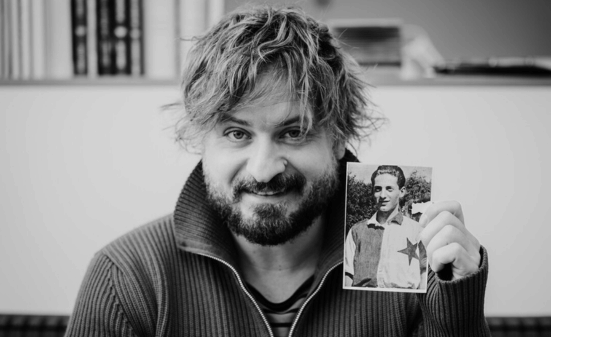
In a new four-part podcast produced by the EVZ Foundation, actor and host Daniel Christensen looks at how official recognition of Nazi forced labor developed after 1945. Drawing on the story of his Czech grandfather, Ludvik Jirus – who was forced to work for the German occupying power as a young man – Christensen retraces the developments that led to the establishment of the EVZ Foundation in 1999 and to compensation payments. Personal accounts, historical eyewitness testimonies and expert voices provide a nuanced portrait of Nazi injustice.
Episode 1 “Forced labor was everywhere”, opens the series: How did the system that sustained the Nazi war economy function, and how did it shape the lives of those affected? In addition to Ludvik Jirus’ story, the episode includes the testimony of former forced laborer Alicja Kubecka. Historians Christine Glauning and Mark Spoerer offer historical context.
Beginning November 27, a new episode will be released every three weeks – on the EVZ Foundation’s YouTube channel and wherever podcasts are available.
|
|
|
Listen to the first episode
|
| |
|
|
EUROPEAN HISTORY FESTIVAL
|
|
|
Take part in HISTODAY 2026 – critical, creative, engaged
|
|
|
|
| |
|
Antisemitism, historical revisionism, polarization and global crises call for new, courageous responses. How we shape remembrance in the future will be crucial to the strength and resilience of our democracies.
As part of its 25th anniversary, the EVZ Foundation invites people of all ages from Germany and across Europe to take part in HISTODAY 2026, a European history festival that takes a critical look at the past and poses bold questions for the future.
Participants shape the program with their wide-ranging contributions: workshops, panel discussions and artistic works that seek to promote an inclusive and forward-looking memory culture in Europe.
|
|
|
Submit a topic proposal and a short biography by January 15, 2026
|
| |
|
|
YOUNG PEOPLE REMEMBER INTERNATIONAL
|
|
|
Personal stories, deep reflection: young perspectives on the Nazi past
|
|
|
|
| |
|
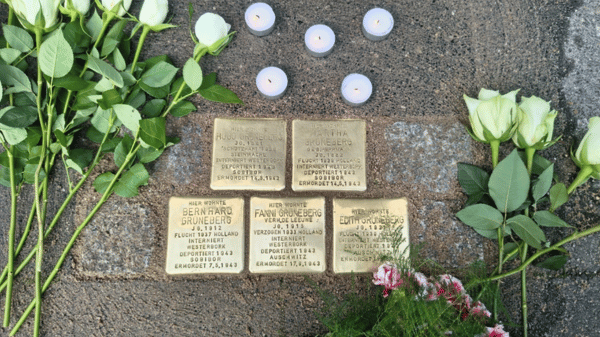
How young people today research, interpret and creatively engage with the history of National Socialism is reflected in three recent projects undertaken under the funding program YOUNG PEOPLE remember international. On November 10, 2025, the German-Dutch project “Following Traces” run by the International Association for Education and Encounter in Dortmund concluded with a ceremonial closing event. One particular highlight was the installation of memorial stones for the Grüneberg family. Thanks to the intensive research carried out by young participants, it has been possible to keep the memory alive of the fate of the five family members murdered in Auschwitz and Sobibor.
|
|
|
Find out more about the project
|
| |
|
|
Short films, photographs and audio pieces: The new website for the project “One History – Many Stories” features personal works that weave together memories, places and communities. Led by Meetingpoint Memory Messiaen, the project brought together young people from Germany, Poland and Ukraine to explore Nazi forced labor through family stories and victim biographies.
|
| |
|
|
The published essay collection “Unknown Past? A Journey to Jewish Life and Holocaust Memorial Sites in the Baltics” examines the history of the Shoah and Jewish life in the Baltic region. It is the result of a study trip by university students to the Baltic states. The contributions range from personal reflections on the emotional impact of memorial sites to analytical discussions of memory politics, cultural identity and the handling of Jewish heritage in the post-Soviet space.
|
| |
|
|
NEW CALL FOR APPLICATIONS
|
|
|
From remembrance to action – apply now for “Young Voices for a Shared Remembrance”!
|
|
|
|
| |
Organized in cooperation with the Franco-German Youth Office (DFJW) and the Regional Youth Cooperation Office (RYCO), this project is aimed at young people aged 18 to 30 who would like to take part in an intercultural project on history and memory cultures. The program focuses on exchange between participants from France, Germany and Bosnia and Herzegovina, addressing remembrance of the First and Second World Wars, Franco-German reconciliation and the Yugoslav Wars, as well as colonization, decolonization and their continued impact today. Across two intercultural encounters – in France in April and in Bosnia and Herzegovina in September 2026 – participants will learn about diverse perspectives, visit sites of memory and explore how these histories continue to shape our societies today.
Participants will also have the opportunity to actively shape the project, contribute ideas for a democratic European culture of remembrance, and put them into practice through their own initiatives.
|
|
|
Apply by December 21, 2025
|
| |
|
| |
|
|
| |
|
|
| |
|
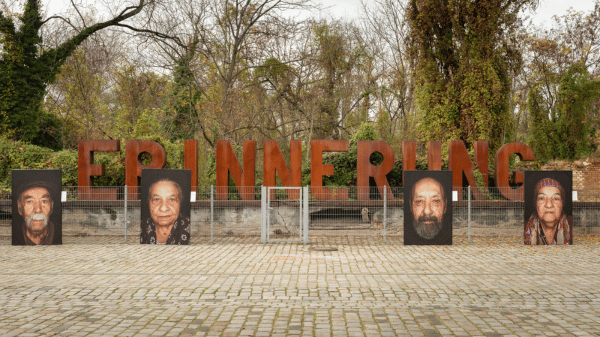
Presented as part of the EVZ Foundation’s anniversary year program of events, the open-air touring exhibition “Ma Bistrass! Gegen das Vergessen” was accompanied by a public talk and an artist-led tour on November 12.
UNESCO Artist for Peace Luigi Toscano traveled through Eastern Europe in the summer of 2024 to meet the last survivors of the genocide against the Sinti/Sintize and Roma/Romnja. The result is a series of large-format portraits that preserve their stories and memories through multimedia elements. For Toscano, his work is a “human project”: it is about engaging in conversation with historical eyewitnesses, many of whom spoke publicly about their lives for the first time. Toscano says that each photograph marks the end of a long process.
The images were exhibited in Germany for the first time, in cooperation with the German Museum of Technology in Berlin. They will remain accessible around the clock at Steinplatz in Berlin-Charlottenburg until December 6, 2025.
|
|
Find out more about the project and the exhibition 
|
| |
|
| |
|
|
|
|
|
| |
|
Christian Pfeil, survivor of the genocide against the Sinti and Roma
|
| |
|
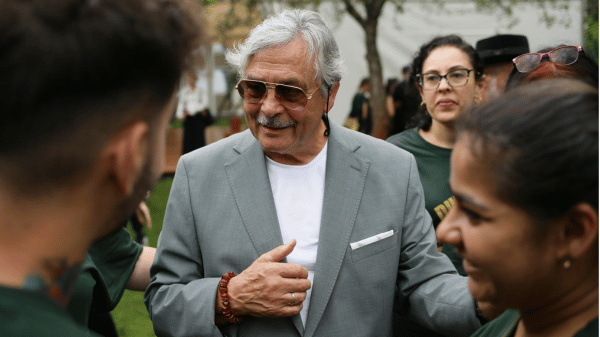
Christian Pfeil was born in 1944 in the Lublin Ghetto in the German-occupied “General Government”, where his family had been deported in May 1940. There they were put into forced labor under orders from the SS and the police. While he and his closest relatives survived this ordeal, many other family members were murdered.
After liberation, the family returned to their hometown of Trier, where Christian Pfeil built a successful career in gastronomy – though repeatedly overshadowed by right-wing extremist and racist attacks. For many years, he has been committed to boosting local remembrance efforts in the city. Pfeil has previously represented the Documentation and Cultural Center of German Sinti and Roma on the International Auschwitz Committee, and he delivered the keynote address on European Holocaust Memorial Day for Sinti and Roma on August 2, 2022 at the Auschwitz-Birkenau Memorial.
When you look back today at your family history and your own childhood, what do you believe is most important for younger generations to understand about your family’s fate and the genocide against the Sinti and Roma?
Young people – including young Sinti – know far too little about what happened and about what my family and all Sinti had to endure under the Nazi regime. Explaining this to them and speaking to them about it is absolutely essential.
The EVZ Foundation was established 25 years ago. What has this meant to you personally – as a survivor and as someone who has been engaged in remembrance work for many years?
For me, the encounters with young people are the most important thing – as on August 2 in Oświęcim, for example. These encounters between survivors and the younger generation have been strongly supported by the EVZ Foundation, and I believe that is absolutely crucial.
When you think about the next 25 years, what do you hope for the future – in terms of remembrance of the genocide against the Sinti and Roma and in terms of the fight against antigypsyism in our society?
I hope I’ll still be around for a long time to come and can continue to talk to young people, to explain to them what happened and share my experience wherever I am invited. That’s incredibly important to me, because as a Holocaust survivor it is my duty to tell my story and that of my family again and again.
|
|
How the EVZ Foundation supports Sinti and Roma in Germany

|
| |
|
|
Holodomor Memorial Day and its continuities in Russia’s war of aggression against Ukraine
Between 1932 and 1933, several million people in Ukraine starved to death as the result of a famine deliberately engineered by the communist totalitarian regime – the Holodomor. This policy of destruction targeted rural regions in particular, where grain was confiscated, freedom of movement was restricted, and people were deprived of the means to survive. The aim was to break resistance in Ukraine, destroy national identity, and establish total control.
In November 2023, Nadija Slesarewa visited the EVZ Foundation. As a survivor of Stalinist terror, the Holodomor, and Nazi persecution in the Stutthof concentration camp, she spoke in a moving interview about the importance of global remembrance of the Holodomor in order to prevent such a crime from ever happening again. She shared her painful memories of a time “when people were dying in a rich and beautiful country.”
In 2022, the Bundestag recognized the Holodomor as genocide against the Ukrainian people – an important affirmation of historical truth, justice, and remembrance of the victims. This recognition also matters in the context of today’s Russian war against Ukraine, in which Moscow once again seeks to delegitimize Ukrainian statehood and erase Ukraine’s identity. The historical record shows that such strategies of violence form part of a long tradition of repressive imperial policy.
Today, remembering the Holodomor is a reminder of why Europe has a responsibility to support Ukraine – politically, in human terms and morally.
|
| |
|
|
EVZ ACADEMY - ONLINE PLATFORM
|
|
|
Digital learning resources on antisemitism, Nazi forced labor and memory culture
|
|
The EVZ Academy provides information and practical experience on memory culture and human rights through an online platform designed for collaborative learning and networking. Below is a selection of featured formats:
Blended learning: antisemitism prevention at the workplace
The project Informed, courageous, committed! A Joint Initiative Against Antisemitism is having a tangible impact: more than 500 participants from 31 organizations including cultural institutions, public administrations and educational institutions now feel equipped to respond confidently to antisemitism in their work settings thanks to the blended-learning program. The project is under the patronage of Dr. Josef Schuster, President of the Central Council of Jews in Germany and has been certified with the Phineo Seal of Impact. It is an interactive learning program which can be integrated directly into company learning management systems. Depending on organizational needs, a range of formats is available for professional development, including workshops, lunch talks, e-learning modules and a practical guide.
|
|
|
Find out more about the project and e-learning formats
|
| |
|
Ausgezahlt?! [Paid Out?!] Is it possible to compensate people who were made to carry out forced labor under the National Socialist regime?
The course Paid Out?! traces the long journey toward recognition of Nazi injustice, the founding of the EVZ Foundation, and the compensation programs. It addresses historical events, the actors involved, fundamental questions surrounding the recognition and compensation of Nazi crimes, and also the unresolved questions of justice that persist to this day.
|
| |
|
Children in war: a topic for educational work?!
Worldwide, one in six children grows up in a war or conflict zone. How can we talk about war without overwhelming children or minimizing the seriousness of violence? Which methods foster empathy, a change of perspective and critical thinking?The EVZ Academy learning platform offers a curated collection of materials and methods that can be used in classrooms, workshops or project settings.
|
| |
|
|
NEW CALL FOR APPLICATIONS
|
|
|
Are you interested in remembrance and film? Become a Film Ambassador for the EVZ Foundation!
|
|
|
In connection with the Augen auf [Eyes open] Cinema Day 2026 we are looking for creative Film Ambassadors aged 18–25 with an interest in history for the period December 2025 to June 2026. The Eyes Open Cinema Day will take place across Germany on January 27 and 28, 2026 to mark the Day of Remembrance for the Victims of National Socialism.Following a joint virtual introduction on December 18 and preparatory training in January with the Cinema Day team, you will independently produce reviews, interviews and social-media contributions at the intersection of historical-political education and film. On Cinema Day itself – in Berlin, Frankfurt am Main or Dresden – you will engage directly with filmmakers, guests and influencers. We look forward to hearing from you!
|
|
|
Submit a short personal introduction by December 15, 2025
|
| |
|
|
EYES OPEN CINEMA DAY 2026
|
|
|
The Eyes open Cinema Day on January 27: when do I raise my voice?
|
|
Remembrance needs places – and new forms of encounter: on January 27 and 28, 2026, the Eyes open Cinema Day will once again be held to mark the Day of Remembrance for the Victims of National Socialism in Berlin, Dresden, Erfurt, Frankfurt/Main, Rostock and Stuttgart.
The Cinema Day will officially open on the evening of January 27 with the premiere of the children’s and family film Das geheime Stockwerk at the Delphi Filmpalast in Berlin, featuring a keynote by Fabian Grischkat and a post-screening discussion with Dr. Andrea Despot and director Norbert Lechner. Across Germany the event will be accompanied by other guests, including Christian Friedel (Dresden), Dr. Gunnar Rikola-Lüttgenau (Erfurt), Luigi Toscano (Stuttgart), Prof. Meron Mendel (Frankfurt), and Eva-Maria Kröger (Rostock).
On the mornings of January 27 and 28, there will be a curated school cinema program featuring filmmakers and experts such as Wesley and Laura Höllenreiner (Stuttgart), Julia von Heinz (Erfurt), Lars Kraume (Berlin), Giulio Ricciarelli (Frankfurt), Johannes Hegemann (Rostock) and Ulrich Limmer (Dresden).
|
|
|
Check here for regular updates on Cinema Day
|
| |
|
|
EVZ FOUNDATION PODCAST
|
| |
Ruins & Dreams: resilience and resistance – what we can learn from Ukrainian civil society |
| |
|
Since 2014, Ukrainian civil society has played a key role in the country’s resistance to Russia’s war of aggression. How can Europeans learn from what is going on in Ukraine and the diaspora? How can we raise awareness that in all its hybrid forms, the war has already taken on a European dimension? And what is needed to jointly build greater resilience in Europe? This was the focus of a discussion between Alona Karavai (curator and cultural manager), Nataliya Pryhornytska (EVZ Foundation), and Dr. Franziska Davies (ZZF Potsdam), moderated by journalist and podcaster Ira Peter.
|
| |
Listen to the new live podcast episode

|
| |
| |
|
|
PORTFOLIO INSTITUTIONELL
|
| |
|
25 years of Remembrance, Responsibility and Future in investment management
|
| |
|
How has the EVZ Foundation’s investment strategy evolved over the past 25 years? Stefanie Hinsdorf, Head of Asset Management since 2023, explains the three core objectives: regular returns, preservation of capital in real terms, and sufficient liquidity.A key milestone came in 2021 with the introduction of an ESG policy. ESG stands for “Environmental, Social, Governance”. The policy stipulates that sectors such as weapons, forced labor, and fossil fuels are excluded from the Foundation’s investments. Such exclusions had been in practice before, but since 2021 they have been formally defined and implemented by five external asset managers.
|
| |
|
Read the entire article in the online magazine starting on page 36
|
| |
| |
|
|
NOVEMBER 12 TO 23 DECEMBER, DÜSSELDORF
|
| |
|
What does liberation mean (here)? – an exhibition on remembrance-focused zines by young people
|
| |
|
This exhibition showcases remembrance-focused zines – self-made booklets or magazines that combine text, images, drawings, collages, and other forms of expression. The works were created at a special workshop reflecting on what liberation from National Socialism 80 years ago meant for survivors. The exhibition is open to the public until December 23, 2025.
|
| |
|
Find out more about the project and the exhibition
|
| |
| |
|
|
UNTIL JANUARY 15, 2026
|
| |
|
Jugendpresse student newspaper competition: #keinBlattVormMund [#SayItOutLoud]
|
| |
How can reporting be fair, accurate, and non-discriminatory? Funded by the EVZ Foundation, the special award Writing Against Exclusion recognizes editorial teams that write with sensitivity and show how language builds respect. For the first time, two school newspapers will receive the award – regardless of age group or school type. Creative contributions are invited, such as reports on memorial stones at your own school, inclusion in day-to-day life, or a photo/video story about respectful interaction.
It’s worth taking part: highlight diversity, show your conviction – and win an award.
|
| |
|
More information about how to apply for the special awards
|
| |
| |
|
|
11. DEZEMBER, 11:00-12:00 UHR, DIGITAL
|
| |
|
Thursday Topic: In the subjunctive of history – AI-generated images between correction and distortion
|
| |
AI image generators can reshape stories with ease: alternative pasts, shifted contexts, fabricated scenes. Science editor Konstantin Schönfelder (ZEVEDI) draws on concrete examples to show the opportunities such visual “corrections” may offer for culture and remembrance – and the risks they pose: pseudo-historical narratives, declining trust in visual evidence, and a competition in which real images can lose out to artificial ones.
How it works: Sign up via EVZ Academy enter the code #Thursday, select the date of your choice and catch up on any missed sessions if you need to.
|
| |
|
Further details
|
| |
| |
|
| issue 01/2026 |
|
| Our next issue will be published at the beginning of January! |
|
|
| |
| The upcoming issue will present the themes and content of the Education Agenda NS-Injustice: Stay tuned! |
|
| All issues at a glance
|
| |
|
|
|
|
|
|
Stiftung Erinnerung,
Verantwortung und Zukunft
Friedrichstraße 200
10117 Berlin, Germany
T +49 (30) 25 92 97-0
F +49 (30) 25 92 97-11
Website
|
| |
|
Responsible:
Dr. Andrea Despot and Jakob Meyer
Editorial:
Sophie Ziegler, Katrin Kowark, Jana Bültge, Sonja Folsche, Antonia Kruse, Nina Kraus
Image Credits:
Volny Chor Archives, Dokuz, Andrii Volgin, Martin Keil, Johanna Strunk, Łukasz Überhuber, Sebastian Gabsch
|
| |
|
|
|
|
|
Follow us
|
| |
|
|
|
|
|
|
|
The editorial team welcomes your opinion on the newsletter and will be happy to answer any questions. We also help with any issues you might encounter: newsletter@stiftung-evz.de
You are receiving this e-mail because you have subscribed to the newsletter of the EVZ Foundation. You can unsubscribe from this information service at any time. To unsubscribe, click here
|
|
|
If you are unable to click the link, please forward this newsletter to newsletter@stiftung-evz.de with the subject line "Unsubscribe".
|
|
|
|
|
|