New projects launching this summer – next call for applications in preparation
In the summer of 2026, over 50 new projects will start in the Education Agenda NS-Injustice funding program. These projects aim to strengthen democratic attitudes and counter antisemitism, antigypsyism, racism and LGBTIQ hostility by conveying the lessons of the National Socialist past in a way that fosters historical awareness, builds empathy, and inspires action. We will keep you updated on our projects here and on our social media channels!
As these new projects get underway, the next call for applications for project ideas is already in preparation. It is expected to be published late summer 2026.
Our Magazine of the Education Agenda NS-Injustice takes a look back at the projects and results of the first funding phase – featuring interviews, firsthand reports, and unique insights into the program’s core themes.
|
| |
|
AWARD |
|
| First place for digital culture of remembrance: Tribunal 45 wins delina Award 2026! |
|
|
| |
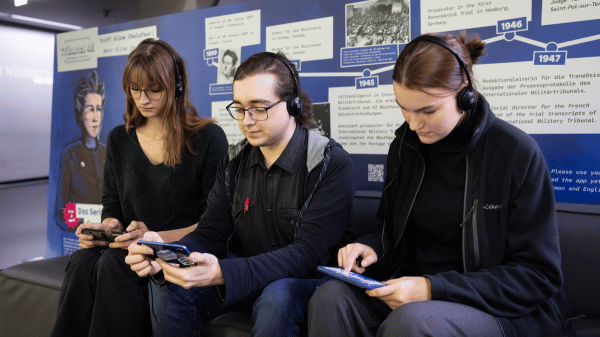
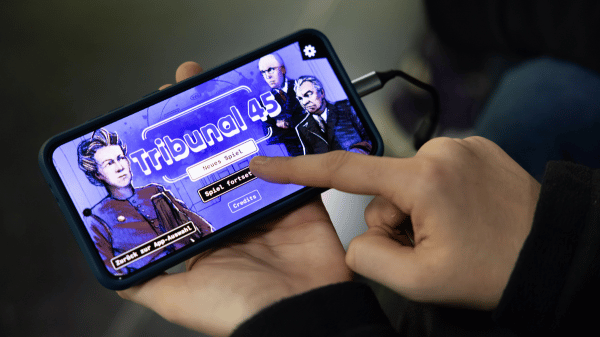
The Education Agenda project and serious game Tribunal 45 – Working on Justice developed by the Memorium Nuremberg Trials has been given the delina Award 2026 in the “Society and Lifelong Learning” category. This prestigious prize, handed out at LEARNTEC, honors innovative digital educational initiatives. The game makes the historical background of the Nuremberg Trial of the Major War Criminals an interactive experience. Stepping into the shoes of French assistant prosecutor Aline Chalufour, players analyze wartime evidence, build legal arguments, and grapple with key issues of international criminal law, asking questions like: What is the difference between a military target and a civilian one? And: What are “crimes against humanity”? |
|
Find out more information about the project and download the serious game  |
| |
|
| EVZ ACADEMY ONLINE PLATFORM |
|
Digital learning resources designed to combat antisemitism and promote historical responsibility |
|
|
| |
The digital learning environment of the EVZ Foundation provides free learning resources on the history of National Socialism, its continuities, and current forms of discrimination, including the introductory e-learning course “Informed, courageous, committed!” on preventing antisemitism in the workplace. The course provides practical knowledge about the history and present of antisemitism, as well as effective strategies for handling antisemitic incidents. The Education Agenda Project of the same name has been awarded the Special Prize, the DEI Corporate Excellence Award, presented by the F.A.Z. Institut.
Also available to explore is the interactive learning module “Compensated?!”, which delves into the long struggle to gain recognition for NS injustices committed against forced laborers and tells the story of the EVZ Foundation.
Both resources are now available in English. |
|
| Visit the EVZ Academy - online platform now! |
| |
|
|
EXHIBITION
|
|
|
Butter, Livestock, Extermination: How Agriculture Became Part of Nazi Rule
|
|
|
|
| |
|
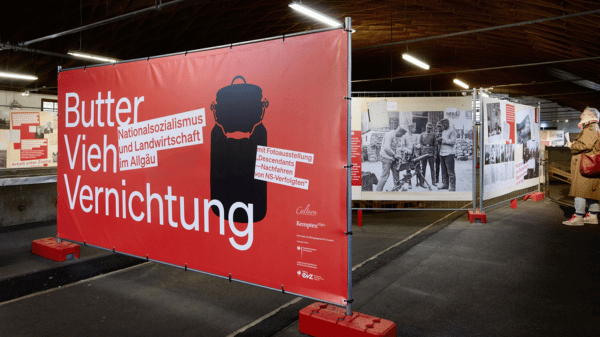
The AlpenStadtMuseum Sonthofen will be showing sections of their touring exhibition on National Socialism and agriculture in the Allgäu until 1st November. The project funded as part of Education Agenda NS-Injustice sheds light on an overlooked aspect of Nazi rule - the intersection of agriculture, food policy, and Nazi ideology. Using historical documents, photographs and personal life stories, the exhibition shows how the agricultural sector was integrated into the war economy, how the “Blood and Soil” ideology shaped rural society and how forced labor or the expulsion of Jewish farmers was part of the everyday reality of the Nazi era.
|
|
Find out more information about the project and the exhibition 
|
| |
|
|
COMMITMENT TO CIVIL SOCIETY IN ISRAEL
|
|
|
Maccabiah Games 2026 - the largest Jewish sporting event, uniting athletics, Jewish life and questions surrounding the culture of remembrance
|
|
MAKKABI Germany will be taking part in Maccabiah Games 2026 in Israel in July with a delegation of around 170 athletes.
The collaboration between MAKKABI Germany and the EVZ Foundation for this event brings together the sporting experiences of Jewish athletes and the Foundation’s expertise in historical and political education.
Given that encounters with historical eyewitnesses are becoming increasingly rare, the goal is to create sustainable, digital educational resources and develop narrative approaches to individual life stories and family memories. This initiative simultaneously makes Jewish life visible and addresses current societal challenges, focusing on interviews and audiovisual formats covering topics such as contemporary Jewish identity, post-1945 remembrance, antisemitism in sport, and sport as a space of belonging.
|
|
|
Find out more
|
| |
|
|
UPCOMING EVENT
|
|
|
From Encounters Comes the Future: A dialog between Germany and Ukraine focusing on resilience, European solidarity, and Third Places
|
|
|
|
| |
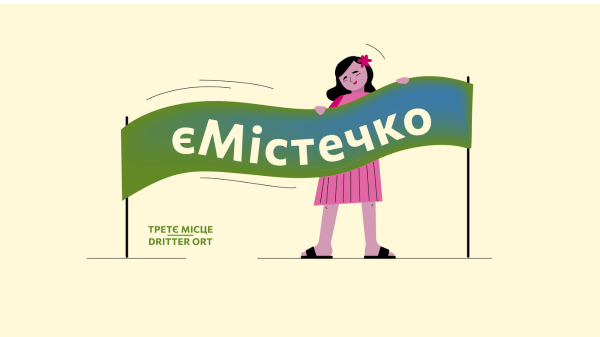
What can Germany and Ukraine learn from each other? And what role do third places play in fostering participation, cohesion, and resilience? Guests from Germany and Ukraine will debate these questions at the Orangerie Theater in Cologne on July 14.
The event marks the end of a German-Ukrainian study trip as part of the EVZ program YeMistechko — Third Places in Ukraine, funded by the Federal Foreign Office. Third places are open meeting spaces such as cultural centers, libraries, and public squares. Against the backdrop of Russia’s war of aggression, they are places of stability and mutual support for many Ukrainian communities.
The program includes insights into the study trip, a fishbowl discussion on resilience and democratic participation, as well as time for networking and sharing experiences while enjoying a Ukrainian buffet. The event will take place in German and Ukrainian with simultaneous interpretation.
|
|
|
Sign up now
|
| |
|
| THÜRINGER VOLKSHOCHSCHULVERBAND E. V. |
|
Remembrance for Everyone: New Materials on NS Injustice in Adult Education |
|
|
| |
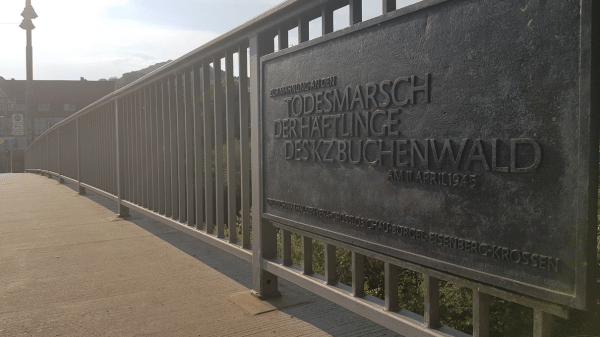
Concentration camps, forced labor camps, deportation sites: The traces of Nazi injustice can still be found today in our immediate vicinity – in small towns, in the countryside, right on our doorsteps. The project Bridges of Remembrance: It was everywhere, developed by Thüringer Volkshochschulverbands e.V., has brought these little-known places into the spotlight and made them accessible for adult education.
A wide range of materials and resources has been created, specifically tailored to different target groups. Teaching materials in Easy Read and Plain German, materials for basic literacy classes, integration courses, and German as a Second Language programs are available, as are materials in sign language and handouts for excursions and walking tours. Alongside this, a participatory training program has been developed for educators to build their confidence in using these materials.
The centerpiece of the project website is an interactive map where visitors can discover remembrance sites and biographies of victims of National Socialism – complete with an overview of local and nationwide memorial initiatives that are committed to shining a light on Nazi injustice. |
|
| All materials and the map of the remembrance sites |
| |
|
Countering Antisemitic Narratives Through Critical Media Literacy
The recently published annual report from the Federal Association of Departments for Research and Information on Antisemitism (RIAS for short) documents 8,725 antisemitic incidents nationwide for 2025. The most frequent manifestation was once again Israel-related antisemitism, which accounted for 68 percent of all cases. 2,314 incidents, roughly a quarter, were documented in the digital space. These figures illustrate the continuing alarmingly high level of antisemitic hostilities that are part of everyday life for Jews. The normalization of antisemitic attitudes and narratives in society reinforces the importance of critical media literacy.
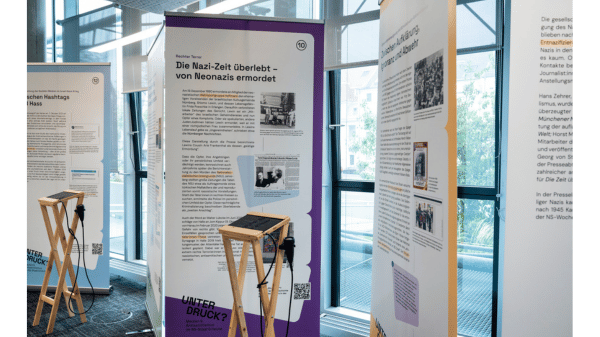
The Education Agenda Project “Under pressure? Media & Antisemitism in the National Socialist State & Today” addresses this very issue. The touring exhibition and the freely accessible digital learning tool show how antisemitism is disseminated, downplayed, and legitimized through the media. Using historical and current examples, they shed light on the role of media in spreading antisemitic visual tropes and enemy images – from the Nazi era to the present day.
While the exhibition presents historical continuities and current developments on 16 themed panels and with five video stations, the interactive modules of the learning platform delve deeper into the workings of antisemitic codes, clickbaits, framing and right-wing agenda setting. They offer practical tips for countering fake news and antisemitism, as well as for fact-checking and media literacy in journalism.
Borrow now: The entire exhibition can be sent by mail for a small fee and set up independently.
|
| |
|
Explore the project, exhibition and learning tool 
|
| |
|
| |
|
| |
|
| |
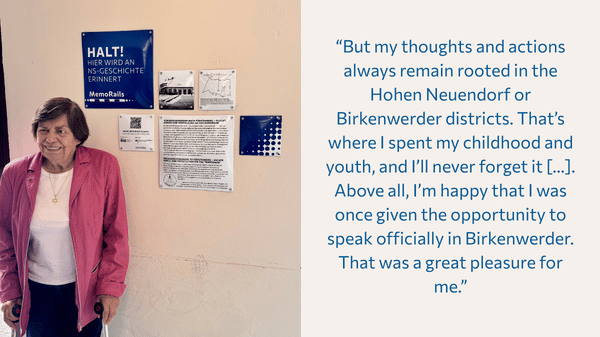
MemoRails is making Nazi history visible at railroad stations
With newly unveiled memorials and exhibitions, the program MemoRails – Stop! This is a reminder of NS history, funded by the EVZ Foundation together with the Federal Government Commissioner for Culture and the Media, has been commemorating local stories of persecution, deportation and forced labor at multiple railroad stations in Germany in the past few weeks.
In Böhlen, a new memorial commemorates NS forced labor in the local lignite mining district, while in Cottbus, an exhibition sheds light on the role of the railroad station as a site of Nazi deportations and prisoner transports. In Birkenwerder, students presented their research findings on Nazi history along the northern railroad line together with the historical eyewitness Ruth Winkelmann. And in Berlin’s Park am Gleisdreieck, teenagers likewise presented the findings of their project on the Nazi history of the Anhalter Bahnhof and the Yorck Bridges.
Further unveilings are due to follow: On July 3rd, a memorial to NS forced labor in rural areas will be unveiled at the Trebnitz railroad station in the district of Brandenburg. On July 11th, a new plaque at the Köln-Deutz railroad station will commemorate the deportations of Sinti and Roma, and Yenish people during the Nazi era.
|
|
| View all upcoming events |
| |
|
| REPORTING AND INFORMATION CENTER ON ANTIGYPSYISM E.V. |
|
| MIA annual report 2025 |
|
| The Reporting and Information Center on Antigypsyism (MIA) documented 2,076 antigypsyist incidents in Germany in 2025 – an increase of 24 percent compared to 2024. Children and young people are affected in one out of every three directly targeted incidents, increasing the risk of lifelong disadvantage. “More and more Sinti, Roma and other people affected by antigypsyism are reporting a steady increase in discrimination, insults, hostility, and violence. Particularly in times of increasing right-wing mobilization, democratic parties and institutions must take a clear stance”, urges Dr. Guillermo Ruiz, the managing director of the MIA. |
|
| Read the report |
| |
|
| Migazin |
|
| Football was meant to cover up mass murder in the concentration camps |
|
Football in the Buchenwald concentration camp offered the prisoners a brief respite from daily life in the camp and its dangers. However, the ball games initiated by the Nazis in the Buchenwald concentration camp merely served to feign normality and conceal the criminal nature of the camp.
The online exhibition "Football and the Buchenwald concentration camp" sheds light on the entanglements between European football and the history of the Buchenwald concentration camp. It displays biographies of persecuted Jewish footballers and club officials, and football-playing prisoners. The exhibition was created as part of the Education Agenda Project “Bridges of Remembrance”. |
|
| Read article |
| |
|
| Brot für die welt |
|
| Atlas of Civil Society 2026 |
|
| Only 3.4 percent of the global population currently lives in countries where freedom of expression, association, and assembly are fully guaranteed. In the CIVICUS Monitor rating, 15 countries have deteriorated compared to the previous year and only three have improved. An active civil society is fundamental to freedom, democracy, and sustainable development. The Atlas of Civil Society 2026 sheds light on the techniques used to suppress civil society. In a new focus section, it examines how disinformation influences opinions worldwide, endangers civil society engagement, and threatens democracy. |
|
| Read dossier |
| |
|
| |
|
|
|
| |
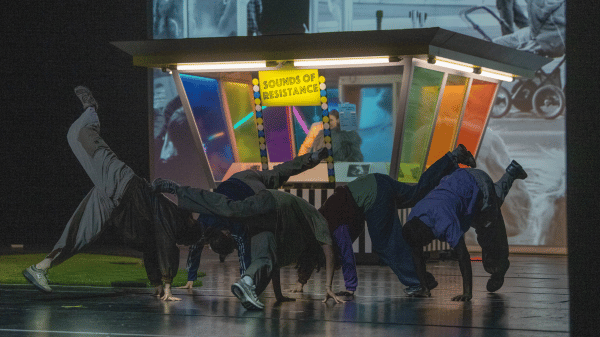
…the Youth Ensemble from Sounds of Resistance, a musical theater project on youth resistance against Nazi injustice |
| |
Can a political movement emerge from dance steps? When does music become the soundtrack of resistance? In the Education Agenda project run by the Theater der Jungen Welt in Leipzig and the Deutsche Oper am Rhein in Duisburg, young actors explored these and other questions about nonconformity, opposition, and resistance. Under the direction of musician and director Schorsch Kamerun and in collaboration with professional artists, two productions were created in the respective cities. There is now also a memorial site at the Lindenauer Markt in Leipzig and a digital sound archive illustrating the history of youth opposition. Cana, Helene and Jonathan told us about their work on Sounds of Resistance – connecting the past with the present and modern-day resistance.
The project focuses on resistance groups like the Leipzig Meuten, the Edelweiss Pirates, and the Ruhr Pirates. What did you know about these groups beforehand, and how did you learn more about them during the project?
Jonathan: To be honest, I didn’t know anything about the Meuten or the Edelweiss Pirates before. I’m not from Duisburg or Leipzig, but when I found out what the play would be about, I started reading up on the topic myself. Later on, during rehearsals, we worked a lot with original sources – audio recordings, leaflets, court rulings – and gradually built up more and more knowledge.
We’re living through a time of growing right-wing extremism, in which democratic values are increasingly under threat. What does resistance mean to you today in light of the latest developments? How can young people take a stand and get actively involved in defending democracy?
Helene: Being open to conversations is something we should all strive for: speak your mind when people make racist, queerphobic, sexist, or otherwise discriminatory remarks. I’ve seen it myself – people getting their information from questionable, farright Instagram or TikTok accounts – and I actively try to talk to them. Taking part in projects like this one is another way to take action and raise your voice.
What are the main takeaways from the project as far as you’re concerned?
Cana: I’ve come to realize that it doesn’t always take big gestures to make a difference. I was really moved by the diversity in our groups and how openly we worked together. And it meant a lot to me to have the
chance to perform in a real opera house. I’ll never forget that. The way I see it, so many different people can get along just fine ... except those who choose to have a problem with that. |
|
| Read the full interview in the Magazine of the Education Agenda NS-Injustice |
| |
|
| NEWSLETTER 08/2026 |
|
| Our next issue comes out at the beginning of August! |
|
|
| |
| In the next issue, we will once again provide updates on projects, upcoming events and future funding calls issued by the EVZ Foundation. |
|
| All issues at a glance |
| |
|
|
|
|
|
|
Stiftung Erinnerung,
Verantwortung und Zukunft
Friedrichstraße 200
10117 Berlin, Germany
T +49 (30) 25 92 97-0
F +49 (30) 25 92 97-11
Website
|
| |
|
Responsible:
Dr. Andrea Despot and Jakob Meyer
Editorial:
Sophie Ziegler, Katrin Kowark, Jana Bültge, Sarah Keller, Meret Aupperle
Image Credits:
Marie Laforge, Sophie Ziegler, Anja Koehler, Stefanie Loos, Tim Händel, Thüringer Volkshochschulverband e. V.
|
| |
|
|
|
|
|
Follow us
|
| |
|
|
|
|
|
|
|
The editorial team welcomes your opinion on the newsletter and will be happy to answer any questions. We also help with any issues you might encounter: newsletter@stiftung-evz.de
You are receiving this e-mail because you have subscribed to the newsletter of the EVZ Foundation. You can unsubscribe from this information service at any time. To unsubscribe, click here
|
|
|
If you are unable to click the link, please forward this newsletter to newsletter@stiftung-evz.de with the subject line "Unsubscribe".
|
|
|
|
|
|
| © Stiftung Erinnerung, Verantwortung und Zukunft, 2026 |
|
|
|
|
|
|