|
Education Agenda NS-Injustice in its second funding phase
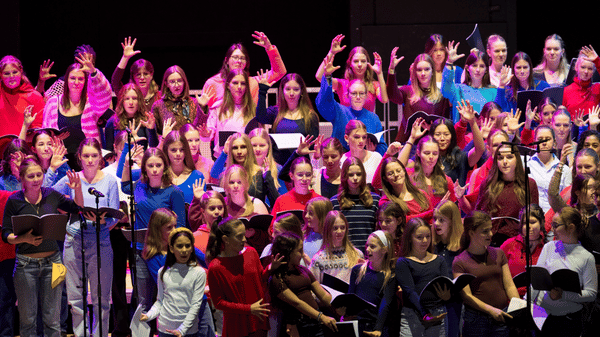
From more than 200 impressive project ideas submitted from the field of extracurricular historical-political educational work on NS injustice, the EVZ Foundation selected around 60 project outlines and invited the project executing organizations to submit full proposals.
Before the new projects begin in summer 2026, it is worth taking a look at the results of the first funding phase – and at our magazine on the Education Agenda NS-Injustice, which features numerous interviews, reports, and insights into the funding program’s thematic priorities.
In this newsletter, we present three projects that examine the issue of Wiedergutmachung (compensation, moral redress) in relation to NS injustice from different perspectives: in the form of oral history interviews with survivors, through the analysis of archival records, and through a digital game.
|
| |
|
TOURO UNIVERSITY BERLIN |
|
| What was truly compensated? |
|
|
| |
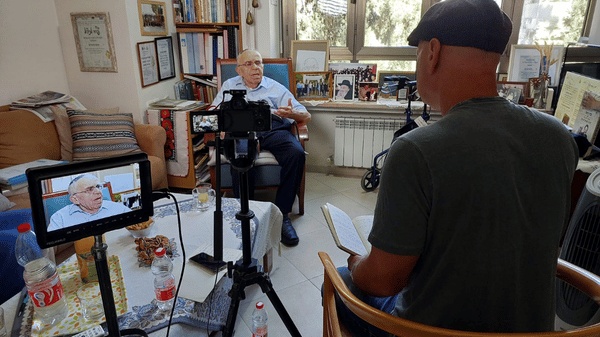
For the project The impact of reparations, Touro University Berlin interviewed survivors of German persecution during the Second World War in seven countries – Germany, Belgium, Poland, Israel, Belarus, Georgia and Latvia. The interviews focus on personal experiences of reparations, i.e. the individual payments made to these survivors, as well as their personal interpretations of the financial benefits they received. The interviews are accessible and permanently archived on the platform Oral-History.Digital operated by the Free University of Berlin. For a related publication, experts analyzed these interviews to show how former victims of persecution view both the material and symbolic aspects of compensation and how they experienced the process. In light of immeasurable suffering and millions of deaths, one central question remains: what was truly compensated? |
|
Order the publication  |
| |
|
| WOLFENBÜTTEL PRISON MEMORIAL SITE |
|
Serious game on NS injustice: four lives, four struggles |
|
|
| |
How did persecution and the lack of recognition continue to affect people after 1945? This question is explored in the serious game Gegen Mauern. Vier Leben, vier Kämpfe [Against walls. Four lives, four struggles], developed by Wolfenbüttel prison memorial site.
The app was created as part of the Education Agenda project 2x(In)justice? Participatory app development on the consequences of compensation for people convicted by the Nazi judiciary, Developed together with students from the educational organization Arbeit und Leben Niedersachsen, the app tells the stories of four men who were imprisoned or executed at the former Nazi prison in Wolfenbüttel. Their historically documented biographies are presented in the form of an interactive graphic novel. The game makes it possible to trace the men’s experience of persecution and their struggle for compensation and recognition, comparing the perspectives of the West and East Germany. |
|
| Find out more and download the app |
| |
|
INFORMED, COURAGEOUS, COMMITTED! |
|
| Project against antisemitism at the workplace nominated for diversity award |
|
|
| |
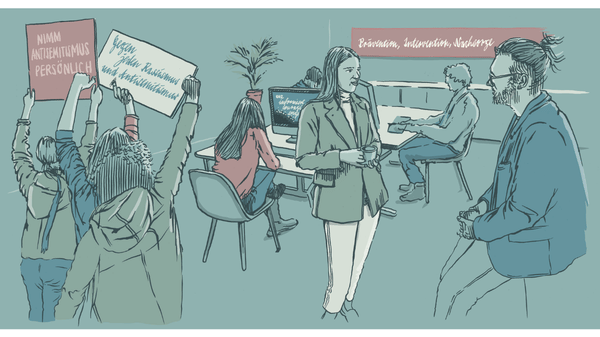
The EVZ Foundation project Informed, courageous, committed! has been nominated as a finalist in the F.A.Z. Institute’s DEI Corporate Excellence Award 2026 in the category “Diversity” – in recognition of its promotion of diversity and inclusive workplace culture.
Since 2022, the EVZ Foundation has offered various educational formats on preventing antisemitism at the workplace, including blended learning formats, lunch talks, and e-learning courses. A new addition is a guide on dealing with antisemitism at the workplace: alongside information on the forms and functions of antisemitism, this offers practical recommendations for prevention and intervention. These offerings are aimed particularly at companies, public administrations, and cultural institutions and can be integrated flexibly into everyday work settings, enabling organizations to take action themselves and benefit from consolidated expertise. |
|
| To the guide |
| |
|
| SANDBOSTEL CAMP MEMORIAL |
|
Conference on children born of “forbidden” relationships in wartime |
|
|
| |
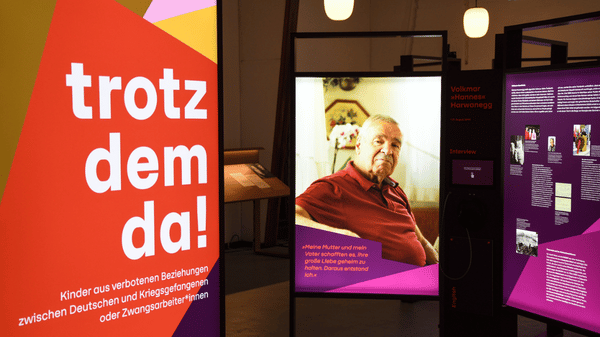
A conference organized by the Sandbostel Camp Memorial and the Nazi Forced Labor Documentation Center will take place on March 19– 21. The event will focus on a largely overlooked chapter of World War II: children born of so-called “forbidden” and socially stigmatized relationships between forced laborers, prisoners of war, German occupation soldiers, and local civilians. The conference accompanies the presentation of the touring exhibition trotzdem da! [Still here!], which will be on view at the Nazi Forced Labor Documentation Center in Berlin through May 2026. Historians, educators, descendants of those affected, and actors in the field of memory culture will discuss historical perspectives, life stories, and transgenerational experiences. The goal is to highlight gaps in research, critically reflect on memory culture, and provide input for new approaches in the area of historical-political education. |
|
| Sign up by March 15 |
| |
|
| ASSOCIATION OF GERMAN SINTI AND ROMA, BAVARIAN REGIONAL ASSOCIATION |
|
Learning from the files: reappraising compensation practices for Sinti and Roma |
|
In collaboration with the Chair of History Didactics at the University of Erlangen-Nuremberg, the Association of German Sinti and Roma (Bavarian regional association) digitized around 1,000 compensation files relating to Sinti and Roma and prepared selected records for use in extracurricular education. A key aspect of the project was the inclusion of different perspectives: alongside the work of the self-organization advocating for the interests of survivors, the perspectives of compensation authorities and state archives were also taken into account. The project outcomes include a collection of essays outlining the different phases of compensation and illustrating these with examples from the digitized files, as well as materials for extracurricular educational work. |
|
| Find out more about the project |
| |
|
|
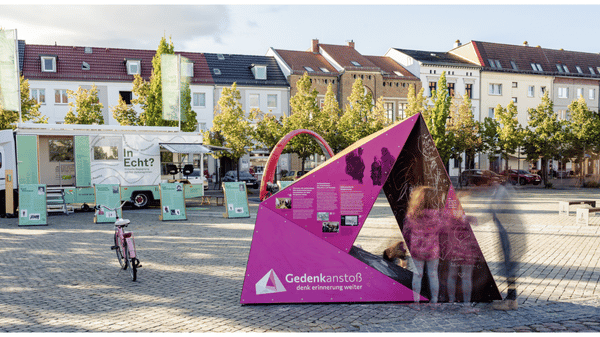
The polygon structures from the EVZ Foundation’s Gedenkanstoß exhibition are now available for loan by project partners and executing organizations for their own exhibitions, for both indoor and outdoor use. Stored at the Foundation’s premises in Berlin, the steel structures can be individually printed with plastic panels.
|
| |
|
| MemoRails |
|
Remembering Nazi crimes at railway stations in Germany |
|
|
| |
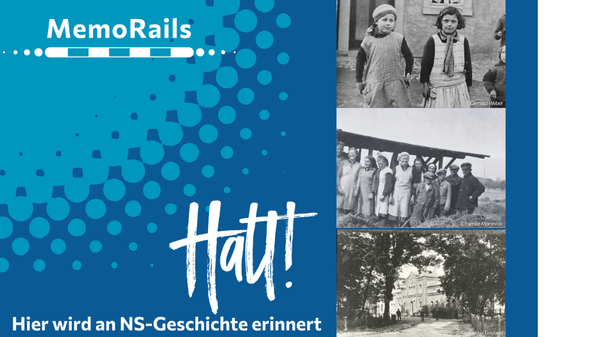
Following extensive research by the 13 executing organizations participating in the MemoRails program, the first commemorative activities are now about to begin. The initiative will launch with the unveiling of the first memorial marker on March 22 in Rödermark, a visible sign commemorating the victims of Nazi persecution and highlighting the importance of local remembrance. The project recalls the Hechts, a Jewish family from Oder-Roden, in particular the tragic fate of 11-year-old Rosel Hecht. Another project by AKuBiZ e.V. explores and commemorates forced labor in the Saxon Switzerland region. More than 900 concentration camp prisoners were deported from the Böhlen satellite camp to Königstein in November 1944. The project highlights the Königstein railway station as a site of crimes committed by the Nazi regime. Story café events will take place in Königstein in March and April. This memorial marker will be unveiled on May 8.
The website is now online as well: featuring a comprehensive overview of all 13 locations and projects, it also provides information on the work of the participating executing organizations. Visitors can find out more about the background, explore the historical context, and trace the history of Nazi deportations. Over the coming months, the EVZ Foundation’s website and social media channels will continue to report on research findings and remembrance activities at the various sites. |
|
| To the website |
| |
|
|
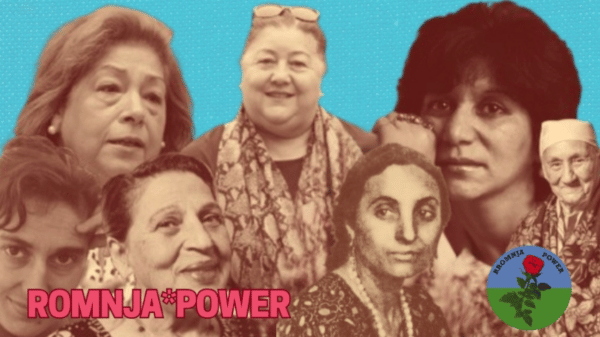
The annual Romnja* Power Month is back!
From March 8 to April 11, the annual Romnja* Power Month once again sends out a powerful signal for visibility and solidarity against antigypsyism. In connection with International Women’s Day (March 8) and International Roma Day (April 8), the initiative organized by the self-organization RomaniPhen e. V. highlights feminist and anti-racist perspectives of Romnja and Sintize. The program combines political action, art, discussion, and collective learning. On March 9, RomaniPhen will participate in the global feminist strike ENOUGH! with actions at the Brandenburg Gate protesting against patriarchal violence and structural inequality. On March 18, the performance QUEER ROM*NJA – Fragmente des Selbst [QUEER ROM*NJA – Fragments of the Self] invites audiences to an evening of drag, poetry, and music. On March 20, an exhibition followed by a panel discussion at the FHXB Friedrichshain-Kreuzberg Museum, entitled Widerstand und Würde [Resistance and Dignity] will explore the struggles of Roma and Sinti from 1945 to the present day. On March 27, an empowerment workshop will offer a protected space for members of the community to exchange experiences and strategies for confronting everyday racism. In addition, on April 11, the premiere will be held of the documentaryGemeinsam sind wir stärker [Together we are stronger], funded by the EVZ Foundation. The film explores the history and present of Roma activism in Germany.
These diverse events bring together culture and activism and link up directly with the demands of March 8: equal rights, protection from discrimination, and solidarity.
|
| |
|
| |
|
| |
|
| |
#notimetoforget – photo competition to mark the 25th anniversary of the EVZ Foundation
Global crises, wars, and digital transformations are reshaping historical-political education and the remembrance of Nazi injustice. Meanwhile, the debate about the use of artificial intelligence highlights the urgent need for responsible handling of images and sources. Through its photo competition #notimetoforget, the EVZ Foundation invites participants to use photography to document how historical-political education is being practiced today. Submissions should highlight developments, challenges, and proven practices in educational work – whether on site, through encounters, or in digital spaces. Projects and individuals aged 18 and over can participate via Instagram or by completing an online form on the EVZ Foundation’s website. The best photographs will receive prize money of up to EUR 2,000 and may be featured as photo of the month in this section of upcoming newsletter issues. |
|
| Photographs can be submitted from March 8 to April 5 |
| |
|
| ANNIVERSARY PODCAST |
|
| 4th episode of Wert & Würde [Value & Dignity]: a piece of democracy |
|
The establishment of the EVZ Foundation was a compromise that, in retrospect, is often seen as overdue yet incomplete. Who was excluded from the Foundation Act, and what happened to those affected? What is the Foundation’s mission today?
Host Daniel Christensen explores the aftermath of the negotiations. Voices from the Foundation itself, the business sector, and survivors illustrate how the compensation programs reached different groups of victims – and who was left out. Katrin Kowark offers insights into the Foundation’s current work and the funded projects it supports to address Nazi injustice. |
|
| Listen now |
| |
|
| UNDERSTANDING UKRAINE |
Twelve years of war, not four |
|
Russia’s attack on Ukraine did not begin in 2022, but in February 2014 with the occupation of Crimea and covert military operations in eastern Ukraine. Between 2014 and 2021, Russia’s war had already claimed more than 15,000 lives and forced more than two million people to flee within Ukraine. Nataliya Pryhornytska emphasizes that this historical and legal accuracy is essential in order to make the suffering of those affected visible and to assume political responsibility. |
|
| Read the essay |
| |
| ARD MEDIA LIBRARY |
| Holocaust: polemics rather than remembrance |
|
A total of 352 politically motivated crimes against memorial sites were recorded in Germany in 2024, 207 of them right-wing motivated. The ARD feature examines how remembrance sites are increasingly becoming targets of graffiti, Nazi slogans, and attacks – especially since October 7. The program Panorama spoke to representatives of more than 130 memorial sites to show how far-right ideologies are undermining remembrance and what challenges arise in terms of preserving memory culture. |
|
| Watch the feature |
| |
|
|
| |
| |
|
|
|
| |
Leonid A. Klimov of dekoder |
| |
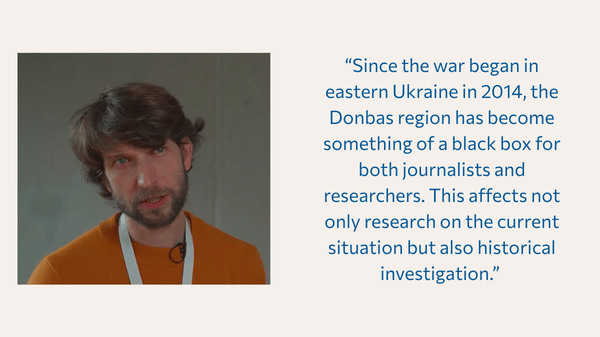
The new Education Agenda project by dekoder is titled Stalino – der Donbas unter deutscher Besatzung [Stalino – the Donbas under German occupation]: Where does the name Stalino come from?
The city now known as Donetsk in the Donbas region was called Stalino from the 1920s onwards. Founded in 1869 as a workers’ settlement, it was originally named Yuzivka, after the Welsh entrepreneur John James Hughes, who established a metalworks and several mines there.
Like many towns in the region, the future Donetsk developed rapidly – but its growth was extraordinary even by Donbas standards. Within just 70 years, the city grew from 200 inhabitants to nearly 500,000. It was also during this period that it was named after the Soviet dictator Joseph Stalin. It was not renamed Donetsk until 1961. |
|
| Read the full interview |
| |
|
| Issue 04/2026 |
|
| Our next issue comes out at the beginning of April! |
|
|
| |
| In the next issue we’ll be back with updates on EVZ projects, upcoming events, and new funding calls. |
|
All issues at a glance  |
| |
|
|
|
|
|
|
Stiftung Erinnerung,
Verantwortung und Zukunft
Friedrichstraße 200
10117 Berlin, Germany
T +49 (30) 25 92 97-0
F +49 (30) 25 92 97-11
Website
|
| |
|
Responsible:
Dr. Andrea Despot and Jakob Meyer
Editorial:
Sophie Ziegler, Katrin Kowark, Jana Bültge, Roos Poncelet
Image Credits:
Thomas Dashuber, Johanna Becker, Oren Dai, RomaniPhen e. V., Gedenkstätte Wolfenbüttel, Johanna Maria Dietz
|
| |
|
|
|
|
|
Follow us
|
| |
|
|
|
|
|
|
|
The editorial team welcomes your opinion on the newsletter and will be happy to answer any questions. We also help with any issues you might encounter: newsletter@stiftung-evz.de
You are receiving this e-mail because you have subscribed to the newsletter of the EVZ Foundation. You can unsubscribe from this information service at any time. To unsubscribe, click here
|
|
|
If you are unable to click the link, please forward this newsletter to newsletter@stiftung-evz.de with the subject line "Unsubscribe".
|
|
|
|
|
|
| © Stiftung Erinnerung, Verantwortung und Zukunft, 2026 |
|
|
|
|
|
|