The third issue of the Education Agenda magazine is out!
Now available online for download from our website or for order as a print version: this new issue features insights into Education Agenda NS-Injustice projects, expert perspectives on history and political education, findings from the latest Gedenkanstoß MEMO Study, and hands-on practical examples – also from the work done by Christian Marx of the Memorial for the Victims of the Euthanasia Killings in Brandenburg an der Havel.
Its publication on September 1 honors the memory of the victims of the Nazi “euthanasia” crimes. In 1940 and 1941 alone, more than 70,000 people stigmatized as “unworthy of life” were murdered in connection with Aktion T4, most of them at the killing centers in Bernburg, Brandenburg, Grafeneck, Hadamar, Hartheim and Sonnenstein-Pirna. A total of more than 300,000 people fell victim to these crimes across Europe. The perpetrators at the six killing centers went on to play leading roles in setting up and managing the extermination camps at Belzec, Sobibor and Treblinka, where around 1.5 million people were murdered in 1942 and 1943 under Aktion Reinhardt – most of them Jewish.
In the magazine, Christian Marx explains why learning about the “euthanasia” murders is key to understanding the Holocaust, how memorial sites are helping close gaps in knowledge, and why young people in particular are calling for forms of engagement, participation and inclusion. The new Gedenkanstoß MEMO study confirms that there is still a lot people do not know in terms of crime scenes, perpetrator networks and the systematic nature of Nazi crimes. Young people are keen to engage, but too often lack low-threshold opportunities to do so.
For this reason, Christian Marx stresses how important it is to keep the memory of the Nazi “euthanasia” crimes alive, not least by providing effective learning spaces and accessible materials.
|
| |
|
evz foundation |
|
| Save the date: New call for applications under the Education Agenda NS-Injustice from fall 2025 |
|
|
| |
The next round of calls under the Education Agenda NS-Injustice projects is expected to be issued in fall 2025. Whether participatory music and theater projects, apps and serious games or collection projects: we support initiatives that raise the visibility of Nazi injustice, promoting engagement with it and creating new points of access for young target groups. Initial questions can be sent to: bildungsagenda@stiftung-evz.de. |
|
Current project calls  |
| |
|
| NAZI FORCED LABOR DOCUMENTATION CENTER |
|
Project makes an impact: Nazi crime site in Greece placed under protection |
|
|
| |
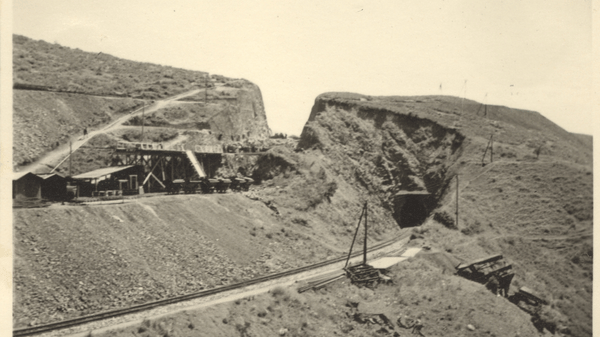
| On the railway line between Athens and Thessaloniki lies Karya station, which has been closed since 2019. An estimated 500 Jewish men were forced to build a railway siding for Wehrmacht trains here in 1943. The cutting for the track is still visible today – yet until recently nothing on site commemorated the forced laborers who died or were murdered here in inhumane conditions. In July 2025, Greece’s Ministry of Culture placed the Nazi crime site at Karya under protection and announced plans to set up a memorial. The catalyst was the Education Agenda project Karya 1943. Forced Labor and the Holocaust, which advised the Greek government on the initiative. |
|
| View project documentation |
| |
|
Touro university berlin |
|
| Conference on the impact of reparations |
|
|
| |
What do survivors of NS injustice today understand by “reparations” – whether material, symbolic or emotional? Staff working on the Education Agenda project The Impact of Reparations interviewed over 50 survivors or their descendants in five countries. Being run at Touro University Berlin, the project taps into new perspectives on remembrance, recognition and social responsibility. It will be presented at a conference in Berlin on September 9– 10, 2025. Experts will also discuss reparations based on the examples of France, Italy and Argentina – countries whose experiences of dictatorship, fascism and occupation produced very different forms of critical appraisal. |
|
| Find out more about the conference |
| |
|
BREMEN ALLIANCE FOR GERMAN-CZECH COOPERATION |
|
| Discover stories of swing and jazz in Bremen and Prague |
|
|
| |
Lots of people pursued their passion for jazz and swing in bars, cafés and concert halls during the inter-war years, but this genre of music and dancing was banned by the Nazis. Created under the Education Agenda project Nazi Injustice: Degenerate Music, the exhibition The Collision of Freedom looks at the National Socialist persecution of swing and jazz culture in Germany and also in occupied Poland and Czechoslovakia. Survivors were able to carry forward the message of music and dance, along with the sense of freedom associated with it. Their memory was honored at the exhibition openings in Gdynia and Bremen with dance and live jazz. The exhibition is on view in Bremen until September 14, 2025. In addition, a film by Josef Lustig about the “ghetto swingers” at Theresienstadt concentration camp will premiere in Prague on September 28, 2025. |
|
| Explore the Bremen program |
| |
|
| |
|
|
| |
|
|
| |
How can Jewish heritage be preserved through music? In the project Soundscapes of remembrance – Sephardic Jews and the memory of the Shoah, the Jewish Chamber Orchestra Munich impressively showcases centuries-old traditions of Sephardic Judaism which were almost wiped out by the Shoah. The production The Keys of Toledo sees the orchestra join forces with the Esims, a Sephardic family of musicians from Istanbul, and actress Alexandra Chatzopoulou-Saia, a descendant of Shoah survivors from Thessaloniki. Music by Evgeni Orkin and texts by Martín Valdés-Stauber weave history, memory and sound into a captivating performance.
The premiere is on September 28, 2025, in Hanover. Further performance venues include Lübeck, Munich and Madrid, and the events will be accompanied by educational programs for young people at local schools. In this way, the project brings Jewish culture to life by blending artistic experience with political and historical education.
|
|
Secure your concert tickets 
|
| |
|
|
For years, the Russian Federation has used the legal instrument of classifying groups as “undesirable organizations” to criminalize independent actors in civil society, academia and journalism. For the organizations in question, this designation effectively amounts to a ban on their work in Russia, with staff and partners facing fines or even prison sentences. The goal is to silence critical voices and suppress democratic engagement. As of August 2025 the list includes more than 250 international organizations, including over 30 based in Germany.
On August 18, 2025, the Prosecutor General's Office of the Russian Federation also declared the Foundation Remembrance, Responsibility and Future (EVZ) an “undesirable organization”. In doing so, Russia disparages the Foundation’s work as a “threat to national security”. The EVZ Foundation firmly rejects this classification and reaffirms its mission to uphold historical responsibility, protect human rights and strengthen democracy. This includes supporting civil society in Ukraine, which continues to suffer under Russia’s illegal war of aggression, as well as assisting Russian exile organizations. Ensuring the safety of project partners remains the Foundation’s top priority.
Also targeted by Russia’s criminalization is the Education Agenda project History Unit: Reframing Queer Narratives in Media, run by the Berlin-based journalists’ association n-ost. The project promotes queer perspectives and the visibility of queer lives in the EU, Eastern Europe and neighboring regions – a vital contribution given that the persecution of queer people in Russia remains a harsh reality. In 2023 Russia’s Supreme Court classified the so-called “international LGBT movement” as extremist.
The EVZ Foundation expresses its full solidarity and support for n-ost and all other project partners that have been criminalized by Russia.
|
| |
|
| |
|
| |
|
| |
Opening in Frankfurt am Main: mobile exhibition For Real? continues its tour
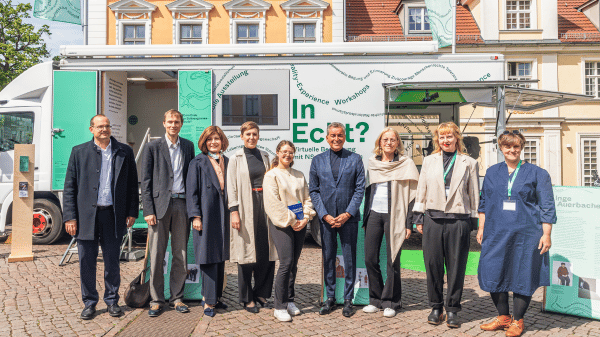
On August 25, 2025, the mobile Education Agenda project In Echt? Virtuelle Begegnung mit NS-Zeitzeug:innen [For real? Virtual encounters with Nazi-era eyewitnesses] opened its fall tour at the German Exile Archive 1933–1945 of the German National Library in Frankfurt am Main. The opening was attended by patron Prof. Dr. Michel Friedman, who has long been closely associated with the Exile Archive.
The exhibition draws on virtual reality to create powerful encounters with five Jewish survivors of the Shoah: Ruth Winkelmann, Kurt Hillmann, Charlotte Knobloch, Inge Auerbacher and Leon Weintraub. The opening was supplemented with a joint program organized jointly with the German Exile Archive, including a youth workshop featuring the innovative approaches adopted by the projects For real? and Just ask! is a project run by the German Exile Archive 1933-1945 that presents digital interactive interviews with Holocaust survivors Inge Auerbacher and Kurt S. Maier in life-size format, embedded in an extensive exhibition.
On its 2025 tour of Germany, the For real? exhibition truck is traveling to Offenbach, Dortmund, Bremen, Neustadt in Holstein and Ahrensbök, stopping at museums, memorials, educational institutions and public squares through to the end of September. The goal is to keep remembrance alive through immersive formats and raise young people’s awareness of historical responsibility. |
|
| Find out more about the project and the tour dates |
| |
|
| RUNDFUNK BERLIN-BRANDENBURG |
|
| Research on AfD parliamentary questions |
|
In the Bundestag, the AfD parliamentary group has recently submitted questions on Belarus – focusing on the EVZ Foundation and also the Belarusian exile organization BYSOL which it supports. Russia and Belarus were suspended from the EVZ Foundation’s Board of Trustees in March 2025. This step was necessary, as “[for the safety of project staff] – we cannot have people holding project descriptions who report back to the governments of Russia or Belarus,” as the Chair of the EVZ Board of Trustees Annette Schavan explained on the program Kontraste broadcast on the German TV channel ARD.“
The Belarusian authorities are now presumably trying to obtain this kind of data through AfD questions in the Bundestag,” says Anshelika Anoschko, a former Belarusian trustee of the EVZ Foundation who now lives in exile. |
|
| To the program Kontraste |
| |
|
| Tagesspiegel+ |
|
| Rediscovering forgotten Jewish writers on a new website |
|
| Created by the European University Viadrina in Frankfurt (Oder), the Digital Archive of Jewish Authors in Berlin 1933–1945 (DAjAB) is a collection of documents relating to more than a thousand Jewish writers persecuted by the Nazis. “It was important to us to give a voice back to the persecuted intellectuals and artists of those years and to make their work accessible to a broader public for the first time,” said project director Kerstin Schoor in an interview with Tagesspiegel. The new archive lists books, newspaper and magazine articles as well as selected secondary literature. It includes more than 4,000 digitized works, along with original documents, photographs and interviews. A historical map of Berlin is also featured that shows where the writers lived. |
|
| Read article |
| |
|
| SÜDOSTEUROPA MITTEILUNGEN, 02-03 2025 |
|
| Yugoslav partisan resistance in the context of European history |
|
The resistance of the Yugoslav partisans under Josip Broz Tito is regarded as the largest popular uprising in occupied Europe during the Second World War. This “people’s liberation struggle” became a central founding myth that shaped remembrance culture in socialist Yugoslavia for decades.
In connection with the international Education Agenda project Wer ist Walter? Resistance in Europe during WW II, four institutions based in Bosnia and Herzegovina, Croatia, Germany and France worked together to highlight Yugoslav partisan resistance in the context of a shared European history of remembrance.
This resulted in three formats: a digital platform featuring 100 resistance stories, a collection of 33 scholarly articles, and the permanent exhibition Wer ist Walter? at the Historical Museum of Bosnia and Herzegovina in Sarajevo.
In an interview, museum director Elma Hašimbegović and historian Nicolas Moll explain why this chapter of history needs to be retold today. |
|
| Full publication for subscribers |
| |
|
| |
|
|
|
| |
Dr. Veronika Heilmannseder, project leader of “Butter, Vieh, Vernichtung” |
| |
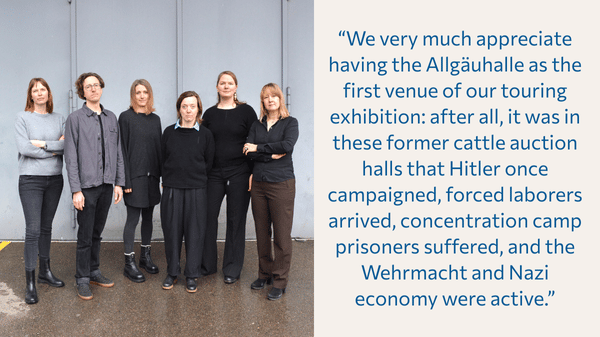
| The project Butter, Livestock, Extermination – National Socialism and Agriculture in the Allgäu Region has held numerous workshops and events aimed at different age groups, opening both historical and personal pathways to the Allgäu region’s Nazi past.
How have creative approaches and formats helped raise young people’s awareness of local Nazi history and its relevance today?
Our creative approaches help bring about a shift from passive knowledge absorption to active engagement. Young people are keen to participate, and in our creative formats they find their own ways of expressing their thoughts. We provide careful expert and artistic guidance to ensure that the facts are genuinely understood and that the creative activities inspire a sense of fun, too. I firmly believe that when young people are given an artistic “voice” to express their perception of local history, they build a lasting connection with the historical heritage of their community and learn to value democratic achievements.
The exhibition Butter, Vieh, Vernichtung – Nationalsozialismus und Landwirtschaft im Allgäu [Butter, Livestock, Extermination – National Socialism and Agriculture in the Allgäu Region] will be on view at the Allgäuhalle in Kempten from September 19 to November 9, 2025.
Find out more about the project in the new issue of the Education Agenda magazine! |
|
| Read more |
| |
|
| september 10, online |
| |
Communicators’ Meet-up: safety first! Security and crisis management at events |
| |
In times of increasing political polarization, events can become places of heated debate. How can such spaces for debate be organized constructively for everyone involved? And what measures should be taken in advance to ensure safety on site and minimize risks? We’ll be discussing these questions at the next Communicators’ Meet-up. This is a networking format aimed at professionals working on memory culture and the history of Nazi injustice. Every three to six months we invite practitioners to share ideas and experiences. This time we look forward to input from Katharina Weiß and Nadine Wothe of the Compassion Crew. |
| |
| Join the network now |
| |
| |
|
| september 17, cologne |
| |
Conference: Under pressure? The complex interplay between media and antisemitism |
| |
| Antisemitic narratives run throughout media history – from the Nazi era to the present day. They continue to shape reporting, fuel conspiracy myths and, not least, put journalists themselves at risk. How can antisemitism be reflected upon in journalistic practice and in everyday newsroom work? And what lessons can be learned from history? At the conference organized as part of the Education Agenda project Under pressure? Media and Antisemitism under National Socialism & Today, experts including Ronen Steinke, Hanna Veiler, Esther Schapira, Laura Cazés, Jörg Reichel and Rosa Jellinek will discuss ways of addressing these challenges. Additional impulses for professional approaches to antisemitism in reporting are provided by supplementary workshops, such as on queer stories in the media as part of the History Unit project, as well as a touring exhibition and a learning tool. |
| |
| Take a look at the program and sign up |
| |
| |
|
| september 18 and 19, berlin |
| |
Networking meeting for Education Agenda NS-Injustice projects |
| |
For the fourth time, the EVZ Foundation is inviting current project executing agencies in receipt of funding under the Education Agenda NS-Injustice to take part in a networking and input meeting in Berlin. Participants will have the opportunity to gain insights into other projects, explore and experiment with the outcomes of their own projects in hands-on fashion in the “Project Gallery Walk”, and network across disciplines. There will be a particular focus on the final phase of the projects: the event provides space to share learnings and best practice, as well as promoting discussion on how to secure project results in the long term. |
| |
| Find out more |
| |
| |
|
| OCTOBER 15 AND 25, ONLINE AND IN TÜBINGEN |
| |
Workshops: Anti-racist approaches to teaching Black German history in schools |
| |
| The Education Agenda project Continuities of Anti-Black Racism before, during and after National Socialism explores the biographies of Black people and develops appropriate anti-racist teaching materials. Drawing on these biographies, participants learn to trace the historical continuities of racism in a way that enables future learners to make active, participatory links with the present. With the help of critical reflection on discrimination, they acquire the skills to promote social justice in schools. |
| |
| Find out more and sign up |
| |
| |
|
|
|
|
|
|
Stiftung Erinnerung,
Verantwortung und Zukunft
Friedrichstraße 200
10117 Berlin, Germany
T +49 (30) 25 92 97-0
F +49 (30) 25 92 97-11
Website
|
| |
|
Responsible:
Dr. Andrea Despot and Jakob Meyer
Editorial:
Jana Bültge, Katrin Kowark, Sonja Folsche, Sarah Keller, Sophie Ziegler
Image Credits:
Paul Bentzen, Johanna Becker, Oren Dai, Eric Müller, Paweł Jóźwiaký, Andreas Assael, Adam Sevens, Thomas Dashuber, Roger Mayrock
|
| |
|
|
|
|
|
Follow us
|
| |
|
|
|
|
|
|
|
The editorial team welcomes your opinion on the newsletter and will be happy to answer any questions. We also help with any issues you might encounter: newsletter@stiftung-evz.de
You are receiving this e-mail because you have subscribed to the newsletter of the EVZ Foundation. You can unsubscribe from this information service at any time. To unsubscribe, click here
|
|
|
If you are unable to click the link, please forward this newsletter to newsletter@stiftung-evz.de with the subject line "Unsubscribe".
|
|
|
|
|
|
| © Stiftung Erinnerung, Verantwortung und Zukunft, 2025 |
|
|
|
|
|
|